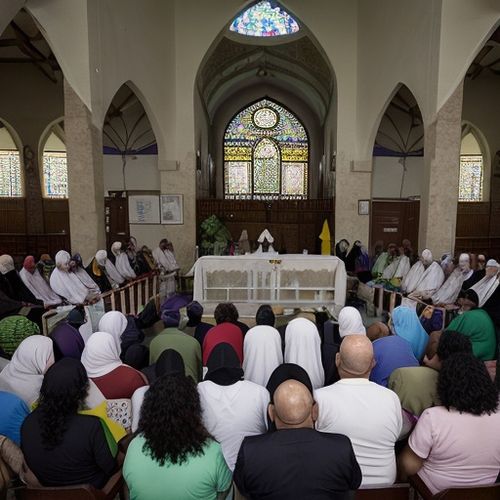
In a nation where religious diversity has often been a source of both cultural richness and occasional tension, Brazil's interfaith mediation groups have emerged as quiet but powerful forces for social cohesion. These grassroots movements, often operating beneath the radar of international media, bring together Catholic priests, evangelical pastors, Afro-Brazilian spiritual leaders, and representatives from smaller faith communities to address conflicts that frequently intersect with religious differences.
The concept took root during the political upheavals of the 1980s, when Brazil's transition from military rule to democracy created both opportunities and challenges for religious expression. What began as informal dialogues between neighborhood religious leaders in São Paulo's favelas and Recife's urban centers gradually evolved into structured mediation processes. Today, these groups operate through a decentralized network spanning at least seventeen states, each adapting their methods to local contexts while maintaining core principles of mutual respect and practical problem-solving.
Unlike formal interfaith councils that focus primarily on theological discussions, Brazil's mediation collectives prioritize concrete interventions in community conflicts. A typical case might involve mediating disputes between Pentecostal congregations and practitioners of Umbanda (an Afro-Brazilian religion) over noise complaints during religious ceremonies. More complex interventions have addressed tensions arising from evangelical expansion into indigenous territories or conflicts between rival drug factions that align themselves with different religious symbols.
The mediators employ techniques adapted from both traditional peacebuilding models and uniquely Brazilian approaches. "We don't start by debating whose God is real," explains Father Marcos Almeida, a Franciscan who coordinates mediation efforts in Bahia. "We begin by identifying shared concerns - a polluted river that affects everyone's children, a street where no elder feels safe walking at night. Common ground emerges through shared problems before we ever touch on doctrine."
This pragmatic orientation has yielded unexpected alliances. In Rio de Janeiro's Complexo do Alemão favela, Muslim merchants, evangelical shop owners, and Candomblé practitioners jointly established a rotating security system for their market area after mediation helped them move beyond mutual suspicions. In the Amazonian state of Pará, Catholic lay workers and neo-Pentecostal farmers formed an unusual coalition to pressure local government against a mining project that threatened both an ancestral cemetery and a popular baptism site.
Challenges persist, particularly regarding funding and scale. Most groups operate on shoestring budgets, relying on volunteer time and occasional small grants from international faith-based organizations. The decentralized nature that gives the movement its adaptability also makes systemic impact measurement difficult. Yet the very informality of these networks may contribute to their resilience - when one mediation initiative falters, others quickly fill the gap through existing relationships.
Recent years have tested this resilience as political polarization has increasingly drawn religious communities into opposing camps. Mediators report spending more time addressing conflicts within faith traditions (such as between progressive and conservative Catholic factions) than between different religions. Some evangelicals now view interfaith dialogue with suspicion, associating it with liberal theological agendas. Meanwhile, Afro-Brazilian religious leaders increasingly demand that mediation address not just interpersonal conflicts but structural racism within Brazil's religious landscape.
The movement continues to evolve in response. Several groups have begun incorporating training on digital communication to combat online religious hate speech. In Minas Gerais, young mediators are experimenting with interfaith hip-hop workshops as conflict prevention tools. Perhaps most significantly, women - who traditionally played background roles in Brazil's religious hierarchies - now lead nearly 40% of active mediation teams, bringing different approaches to reconciliation.
As Brazil approaches its next electoral cycle, with religious rhetoric likely to intensify, these quiet peacebuilders may face their greatest test yet. Their two-generation experiment in grassroots religious diplomacy offers lessons far beyond Brazil's borders - not as a perfected model, but as living proof that even in fractured societies, the sacred can become common ground rather than battleground.

By Grace Cox/Apr 19, 2025
By Sarah Davis/Apr 19, 2025

By Noah Bell/Apr 19, 2025
By Victoria Gonzalez/Apr 19, 2025

By Daniel Scott/Apr 19, 2025

By Elizabeth Taylor/Apr 19, 2025

By David Anderson/Apr 19, 2025
By Benjamin Evans/Apr 19, 2025
By John Smith/Apr 19, 2025

By Christopher Harris/Apr 19, 2025

By James Moore/Apr 19, 2025
By Amanda Phillips/Apr 19, 2025
By Thomas Roberts/Apr 19, 2025
By Amanda Phillips/Apr 19, 2025
By Elizabeth Taylor/Apr 19, 2025

By David Anderson/Apr 19, 2025
By Daniel Scott/Apr 19, 2025
By James Moore/Apr 19, 2025
By Daniel Scott/Apr 19, 2025
By Olivia Reed/Apr 19, 2025